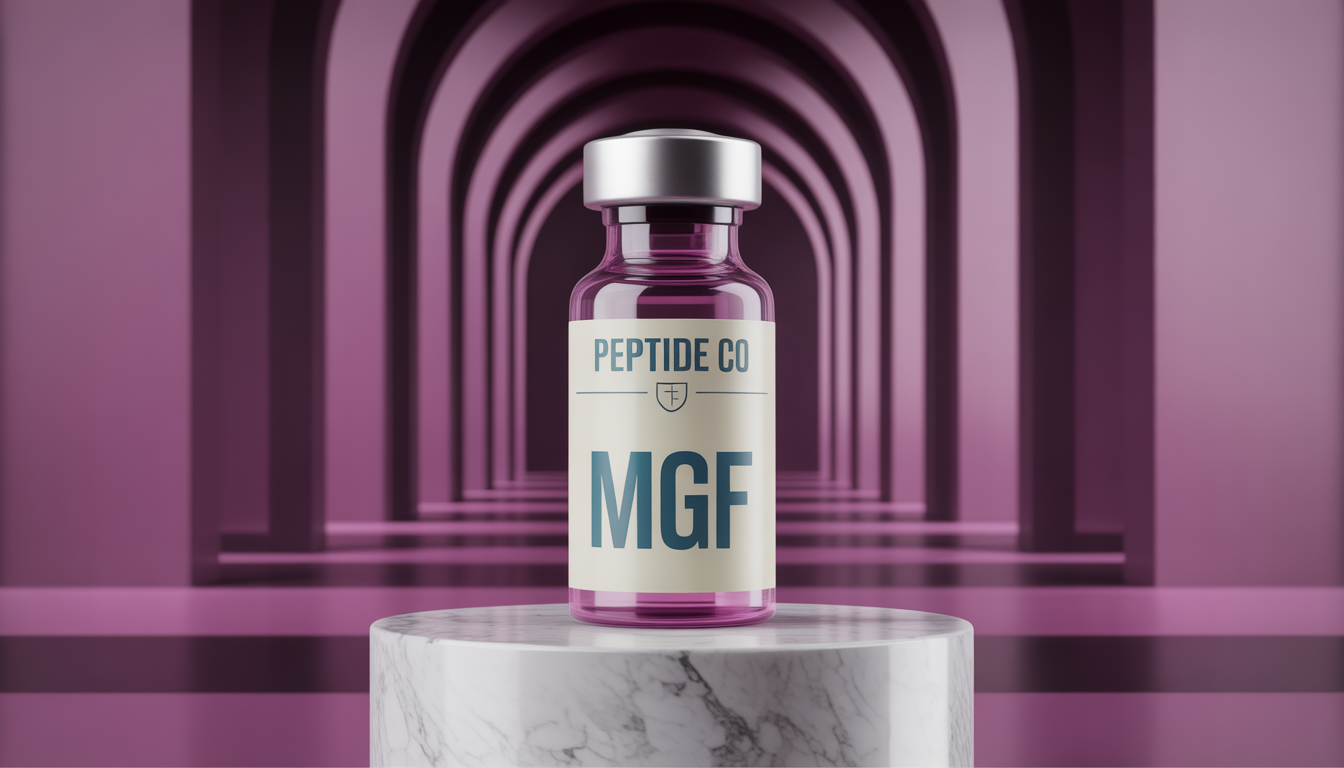
MGF
MGF (Mechano Growth Factor) is a splice variant of IGF-1, specifically IGF-1Ec, produced naturally by muscle tissue in response to mechanical stress and damage from resistance training. Unlike systemic IGF-1, MGF is a localized, autocrine/paracrine signaling peptide that activates muscle satellite cells and initiates the repair and growth of damaged muscle fibers. The synthetic version mimics this natural peptide and is researched primarily for site-specific muscle hypertrophy and recovery. Native MGF has a very short half-life of just a few minutes, which makes it best suited for immediate post-workout administration directly into the trained muscle group.
When muscle fibers undergo mechanical stress or microtrauma during resistance training, the body produces MGF locally as the first wave of the repair signal — preceding systemic IGF-1 release. MGF binds to a unique receptor distinct from the standard IGF-1 receptor and activates muscle satellite cells (myogenic stem cells located between the basal lamina and sarcolemma of muscle fibers). These activated satellite cells proliferate, differentiate, and fuse with existing muscle fibers, donating their nuclei to support hypertrophy and repair. MGF also upregulates protein synthesis and reduces protein degradation in the local muscle environment. Because the peptide degrades rapidly, its action is naturally restricted to the area of injection or natural release, making it useful for targeted muscle group research without systemic IGF-1 elevation.
- Activates muscle satellite cells for hypertrophy and repair
- Localized action allows site-specific muscle group targeting
- Mimics the body's natural first-wave response to muscle damage
- Promotes protein synthesis in the trained muscle
- Supports recovery from training-induced microtrauma
- Does not significantly elevate systemic IGF-1 levels
- Useful for lagging muscle group research protocols
- Complements full-body anabolic protocols with site-specific action
- Injection site redness, swelling, or irritation
- Mild localized soreness at injection site
- Possible transient flushing or warmth
- Minimal systemic side effects due to localized action and short half-life
- Theoretical concerns regarding IGF-1 pathway activation and cell proliferation
- Not approved for human use; sold strictly for research purposes
- Long-term safety profile in humans has not been fully established
- Consult a qualified medical professional before any use
Must be administered post-workout to align with the natural MGF release window Inject directly into the trained muscle group for targeted hypertrophy research Pairs with PEG-MGF for combined localized and systemic satellite cell activation Synergistic with CJC-1295 / Ipamorelin for amplified GH and IGF-1 axis support Stacks with IGF-1 LR3 in advanced muscle growth research protocols Complements BPC-157 and TB-500 in recovery and repair protocols Best used immediately after training, ideally within 30 minutes post-workout Typical research dosing: 200-400 mcg per muscle group, post-training only Not effective on non-training days due to rapid degradation Reconstitute with bacteriostatic water; refrigerate after mixing Use within 2-3 weeks of reconstitution for peptide stability Some researchers prefer single-use vials due to MGF's instability in solution
Select your preferred supplier and add to cart. Prices shown include VAT.
| Supplier / Lab | Strength / Volume | Price | Availability | |
|---|---|---|---|---|
|
UP
UPA Labs
Australia
|
5mg
1 Vial
|
R500
|
In Stock | |
|
KE
Keifei Pharmaceuticals
Malaysia
|
2mg
3 Vials
|
R1,090
|
In Stock | |
|
CO
Cooper Pharmaceuticals
South Africa
|
2mg
10 Vials
|
R2,990
|
In Stock |